A newly introduced federal bill seeks to heighten security at American schools by encouraging districts to adopt social media monitoring programs.
The controversial practice, which uses algorithms to crawl and index public profiles of popular sites like Twitter and Facebook, has grown in popularity over the last several years, as administrators look to new and emergent technologies to heighten school safety — and potentially head off the next mass shooting.
Now the Restoring, Enhancing, Securing, and Promoting Our Nation’s Safety Efforts Act or RESPONSE Act, introduced by Texas Sen. John Cornyn, advocates for numerous policies aimed at increasing school security, including a “Children’s Internet Protection” amendment that encourages districts to invest in programs that detect “online activities of minors who are at risk of committing self-harm or extreme violence against others.” Under the bill, almost all federally funded schools would be required to install software of this kind.
The bill comes at a time when schools are already investing more heavily in this technology. Earlier this year, a review by the Brennan Center for Justice of self-reported procurement orders from schools across the country showed that the number of school districts purchasing such software rose from just 6 in 2013 to 63 in 2018…
While there is a growing demand for these services, researchers are largely split on whether these programs actually prevent violence.
“Aside from anecdotes promoted by the companies that sell this software, there is no proof that these surveillance tools work,” the Brennan Center report concludes, also critiquing the software’s propensity for error, and the kinds of misinterpretation that can take place when machines sift through the slang-saturated conversations of teenagers.
When paired with other forms of surveillance, the software has concerned critics for its broad reach and lack of public oversight.
The Aspen Institute, for instance, recently released a brief report on data collection at school systems in Florida, where the state’s Department of Education recently launched a controversial Schools Safety Portal (FSSP). The portal mandates that state schools collect large amounts of student data — a process that is augmented by the deployment of social media monitoring programs.
The report argues that “preventing school shootings through data is fraught with ethical and technical risks, including a lack of data quality and the potential for biases across multiple levels of predictive algorithms.” The report doesn’t outright indict the practice itself, arguing instead that policies should be developed to increase process transparency and accountability, while deploying experts to ensure data quality.
The RESPONSE Act has seen significant support among a constellation of mental health and law enforcement organizations. In October, the bill was referred to the Senate Committee on the Judiciary where it is awaiting further review.
After a public health crisis in Flint, Michigan, triggered by high levels of lead in the drinking water, a number of programs are working to encourage good nutrition for children in order to prevent recurring effects of the neurotoxin on growing bodies. John Yang reports.
There’s a scene in the movie Mean Girls where new student Cady Heron gets a lesson from her friend, Janice Ian, about the social hierarchy of the high school cafeteria.
“Where you sit in the cafeteria is crucial,” Janice says. She then maps out the cliques, including preps, jocks and, of course, the “plastics.
The scene is an exaggeration of a common experience: the stress of finding your place in a school cafeteria. But Wisconsin resident Smitha Chintamaneni can’t relate.
“I’ve never had that experience,” she said. “I’ve never been at the cool kids’ table or the nerd table. We never had that at my school.”
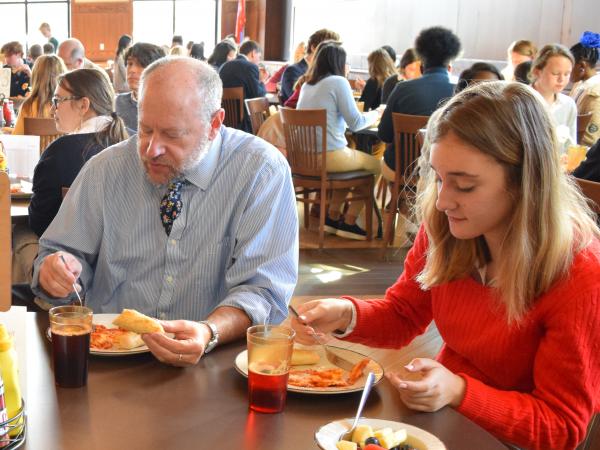
Chintamaneni is an alum of the University School of Milwaukee, a private K-12 school in the suburb of River Hills. One of the most unusual things about the University School is its long-standing tradition of assigned lunch seating.
For new students, the seating rules can be a welcome relief. Sophomore Kylie Burger went to public elementary and middle schools before coming to the University School her freshman year of high school.
“At first I was really hyped,” said Kylie, 15. “I moved a lot with middle school, and usually I would sit alone. So I was excited to not sit alone at a table all year.”
The students are randomly assigned to eight-person circular tables, which rotate depending on that day’s schedule. Each has a mix of kids from different grades, with one teacher whose job is to get the table talking. Kylie says it doesn’t always go as planned.
“Sometimes it gets super awkward at tables,” she explained. “Like the conversation goes, ‘OK, what did you just come out of?’ ‘Math.’ ‘OK.’ And that was really kind of where it ends.”
Read more about School Lunch Assigned Seating at HERE
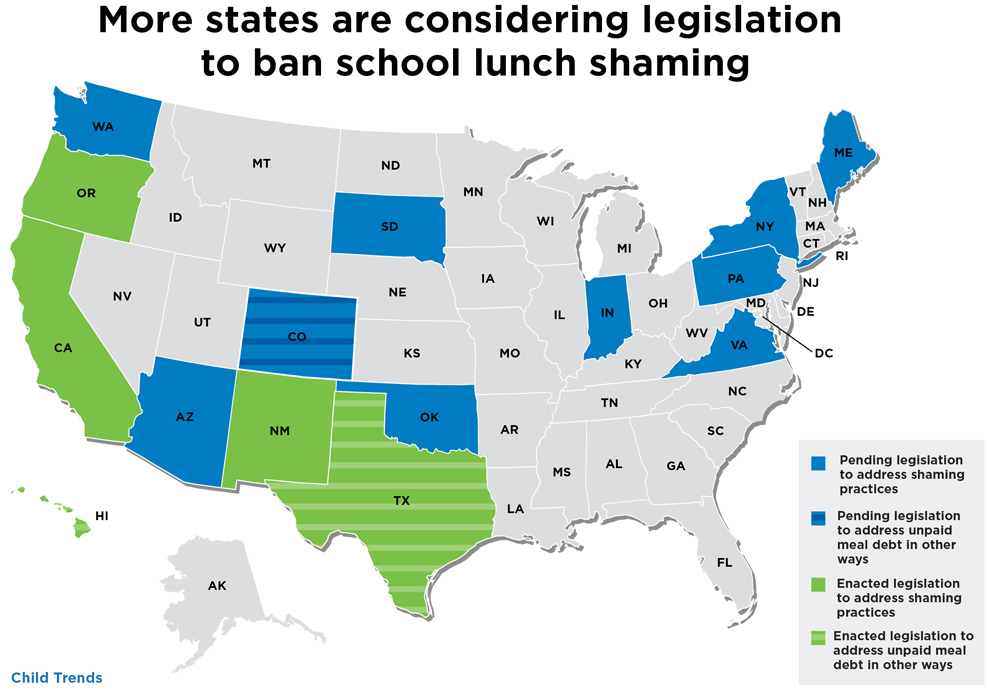
(CNN) California just took a step toward making its school environments a little more inclusive and eliminating school lunch shaming.
Gov. Gavin Newsom signed into law a new piece of legislation that guarantees all students will receive lunch even if their parents or guardians have not paid their meal fees.
The bill, authored by state Sen. Robert Hertzberg, says students shouldn’t be denied a meal of their choice because of unpaid fees. It also ensures “that the pupil is not shamed or treated differently from other pupils.”
The legislation also addresses ways to more effectively notify parents and guardians of a negative balance.
Newsom’s support for the bill was in part inspiredby a young boy, the California governor said. “Earlier this year, Napa County elementary school student Ryan Kyote called national attention to how kids at his school were shamed and singled out because of inadequate funds in heir school lunch accounts,” Newsom said in a statement.
The 9-year-old boy gathered his allowance — all $74.80 of it — and used it to pay off his third grade class’s lunch debt. “He showed how at many schools across the country, students whose parents are not able to pay for their lunch are given a cheaper, ‘alternative’ lunch that causes them to stick out from their peers,” the governor said in his statement.
The two met earlier this year, the governor said. “I want to thank Ryan for his empathy and his courage in bringing awareness to this important issue,” Newsom said in a statement. Kyote isn’t the only young student to bring attention to the issue of student meal debt.
School lunch debt in the US has frequently made headlines in the past few months.
A survey by the School Nutrition Association found that three-fourths of school districts reported having unpaid student meal debt at the end of the 2016-2017 school year.
The facial recognition market is a fast-growing industry expected to generate a value of almost $9B annually by 2022. Part of that market includes the education sector.
Currently, governments are the biggest consumers of this technology because of its ability to deter crime. The “eye in the sky” watching over everyone is able to detect facial features, allow expedient access or deny it, and identify persons of interest. Large cities like Chicago and Detroit have already opted into using biometric recognition.
Some people find Big Brother technology comforting, and others find it invasive. What if this same software is used in the schools your children attend or where you teach?
Uses for facial recognition software in education
There’s no doubt that technology has made it possible to get more done in a day. Where we once had to perform many tasks in education by hand, we now use technology as an assistant.
Software helps teachers provide customized lessons, analyze data, and even keep track of behavior. Technology saves teachers time, which something they don’t have a lot of. Think about all the clerical tasks a teacher performs each day, like taking attendance or recording which students eat lunch in the cafeteria, and which foods they select.
Facial recognition software can significantly reduce the time teachers spend performing clerical duties like these. Students actions and behaviors can be matched to a face, and then the information is either shared (with the registrar/attendance clerk and the food services department) or stored for later access.
The teacher is free to spend more time preparing or delivering instruction.
Facial recognition software can also shorten the time students take to log in to learning programs. Within a second, the software maps facial features and approves access, saving students from having to log and type a password each time they want to use a computer.
“Your child has been sent to school every day without money and without a breakfast and/or lunch,” read the letter, which was signed by Joseph Muth, director of federal programs for the Wyoming Valley West School District. “This is a failure to provide your child with proper nutrition and you can be sent to Dependency Court for neglecting your child’s right to food. If you are taken to Dependency court, the result may be your child being removed from your home and placed in foster care.”
This letter is just one of many recent examples across the country of students and families being penalized for failing to pay their debt from school meals.
In Rhode Island, two school districts began using collection agencies to recover school lunch debt. In one district, the debt had reached $90,000.
What does this issue reveal about American families? And what impact does it have on students?
Some states are seeing school lunch debt soar into the millions of dollars, but the exact amount of lunch debt schools nationwide have accumulated collectively isn’t known because the U.S. Department of Agriculture doesn’t collect or provide that data. As an issue that disproportionately involves marginalized families — those in poverty, living paycheck to paycheck, or even undocumented immigrants afraid to participate in the federal free lunch program — lunch debt magnifies the widespread economic and structural inequities that have historically existed in the U.S. It also has a very real effect on children — whether causing them [to] go hungry (since school meals are the only meals some children eat in a day), hurting their self-esteem, or both.
Nutritionists and dietitians from around the country are working to made kids’ school lunches healthier and more delicious.
The School Nutrition Association hosted its 73rd annual National Conference this week at the America’s Center Convention Complex in downtown St. Louis. The two-day convention allowed school nutrition professionals from around the country to sample food and recipes, test equipment and software, and share the best practices for meeting federal nutrition requirements.
More than 350 companies set up booths and handed out samples on Monday and Tuesday. Chef and Registered Dietitian Brenda Wattles writes recipes for school lunches nationwide. She stresses the importance of creating meals catered to kids and teens with changing palates.
“We see kids’ pallets increasing. We see a trend in the rise of ethnic foods, they want to try a lot of different flavors,” she said.
During the convention, experts sampled meals like ramen bowls and Korean barbecue. They’ll then decide whether school children in their area would benefit from offering it on the school’s lunch menu.
Wattles said the focus is on incorporating fresh fruits and vegetables into each meal. She hopes healthy meals like kale salad with chicken and black bean burgers will inspire children and teens to make nutritious meals a priority.
“Sometimes it takes them 10 times to try something before they eat it.” Said Wattles.
Experts said many of these options could come to school lunch menus across the country in the next year.
A 9-year-old boy is reaching into his piggy bank to help his classmates in Napa, California. Ryan Kirkpatrick used his allowance to pay off the lunch debt for his entire third-grade class.
KGO reported that Ryan became inspired to take action after talking to his mom, Kylie Kirkpatrick, about kids who couldn’t afford school lunches.
Ryan then asked his mom to find out how much was owed by his fellow third-grade classmates at West Park Elementary School. That amount came out to be $74.50.
Kylie Kirkpatrick told KGO, “It was, I think, $74.50. So I took that email and came to Ryan and said, ‘What do you want to do,’ and he said, ‘I guess I can pay for it.’ And I said, ‘Are you sure?’ And he said, ‘Yes.'”
Ryan said that he would typically use his allowance to purchase sports gear.
This time, he gave it all to the school.
The school district policy says that students who have a negative lunch account will still receive a hot meal.
Depending on income levels, elementary school meals range in price from .30 cents to $3.25, KGO reports.
“I want them to realize people actually think about them because you’re just bragging about stuff. I want them to feel happy someone cares about them,” Ryan said to KGO.
Chris Hemsworth is a dad with many talents — and that includes making his children’s school lunches!
The 35-year-old Avengers: Endgame star stopped by his children’s school on Monday to help fellow parents prepare sushi rolls for lunch. (Parents in Australia are encouraged to visit their children’s school to help out in making meals for students.)
His wife, actress Elsa Pataky shared several videos of herself and Hemsworth working together with other parents and hilariously comparing their respective piles of sushi roles just waiting to be consumed by young kids.
“I might have a bigger pile than you do right now,” Hemsworth jokingly told her as she filmed him rolling up the meals.
As he continued working, he sang, “Roll, roll, roll your boat.”
Pataky lovingly wrote, “Always helpful to have a superhero in the kitchen!!” as her husband was seen packing up containers containing lunch ingredients.
An Indiana school district is taking steps to make sure kids have enough to eat.
Elkhart Community Schools students usually get breakfast and lunch at school lunch food, but on the weekends at home, they may be without food.
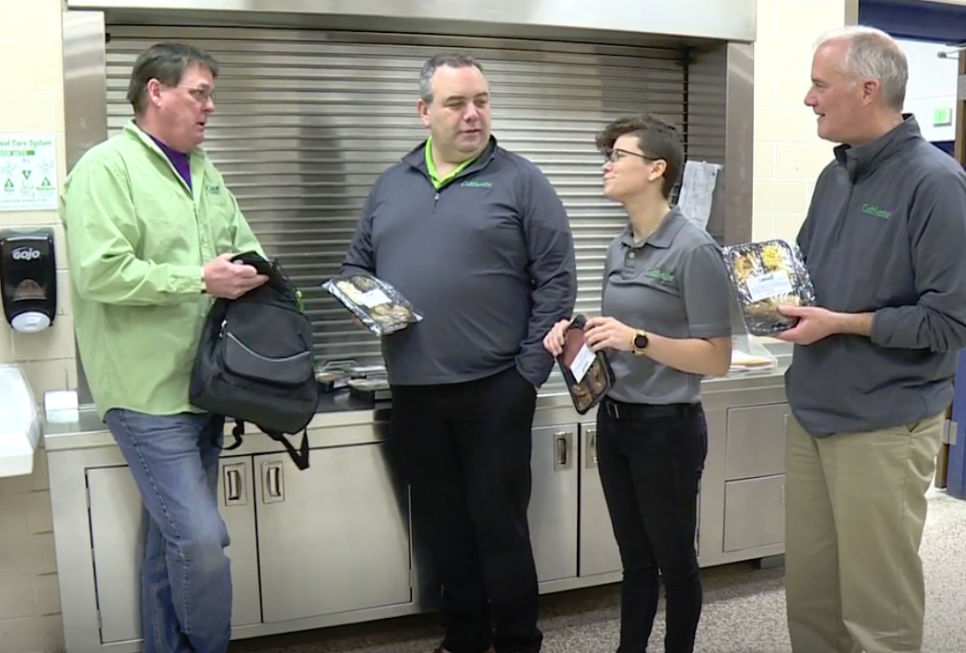
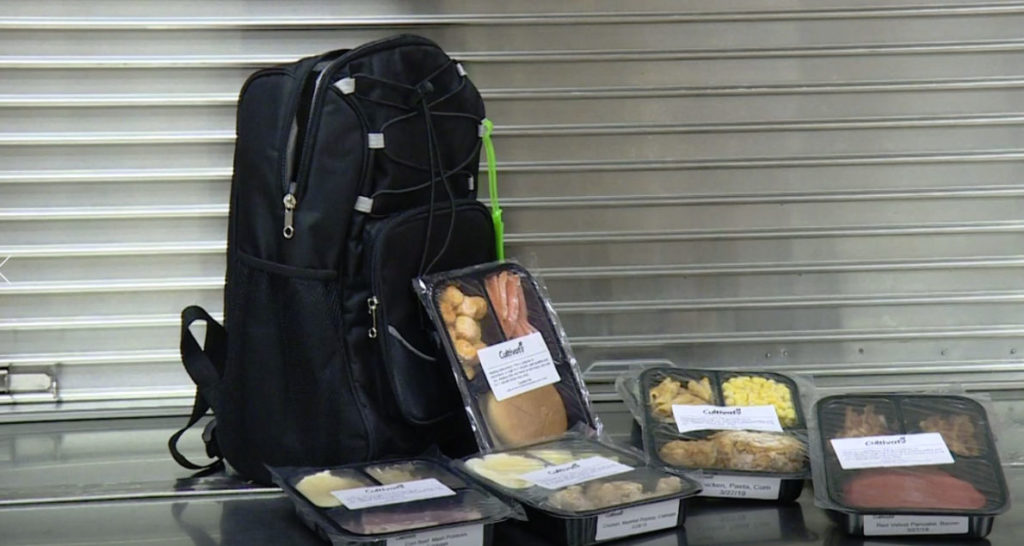
That’s where the South Bend-based non-profit Cultivate Culinary comes in: it provides weekend meals to a small group of students in the elementary school pilot program.
“Mostly, we rescue food that’s been made but never served by catering companies, large food service businesses, like the school system,” said Jim Conklin of Cultivate Culinary. “You don’t always think of a school.”
It rescues the unused food.
“Over-preparing is just part of what happens,” said Conklin. “We take well-prepared food, combine it with other food and make individual frozen meals out if it.”
Twenty students will receive a backpack with eight individual frozen meals every Friday until the end of school.
“At Elkhart Community Schools, we were wasting a lot of food,” said Natalie Bickel, student services. “There wasn’t anything to do with the food. So they came to the school three times a week and rescued the food.”
The Chamber of Commerce’s Leadership Academy Commerce helped get the pilot program going.
“It’s making a big impact,” said Melissa Ramey, Chamber Leadership Academy. “I am proud of that. It was heartbreaking to hear that children go home on the weekends and that they don’t have anything to eat.”
It’s making a big difference in the lives of the students receiving the meals. The Elkhart school system wants to expand the food program to other schools.







 Contact